Introduction
With the UK striving to reach its ambitious net-zero carbon targets by 2050, the demand for renewable energy solutions is higher than ever. Solar energy, particularly for residential rooftops, has emerged as a frontrunner. It offers homeowners a chance to not only lower their carbon footprint but also secure significant long-term savings on electricity bills. However, despite the falling costs of solar technology, the initial upfront expense remains a substantial barrier for many.
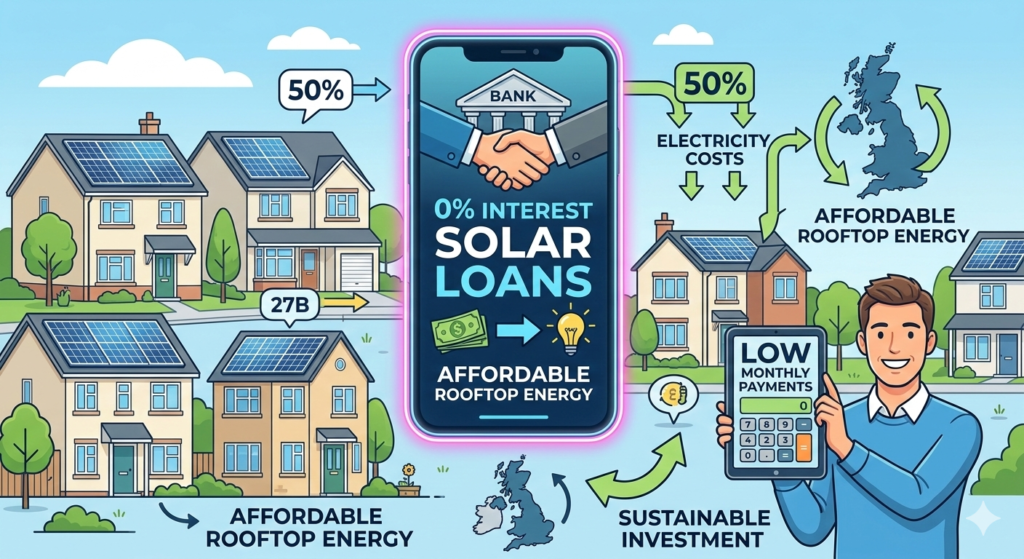
Recognising this challenge, the UK government and financial institutions have introduced innovative financial solutions, most notably 0% interest loans. This approach is revolutionising how homeowners view renewable energy investment. In this comprehensive guide, we will explore exactly how these 0% interest solar loans: How the UK is making rooftop energy affordable are changing the landscape and how you can take advantage of them.
Understanding the Surge in Solar Power demand in the UK
Before diving into the specifics of 0% interest financing, it’s essential to understand why solar has become so popular.
Historically, the UK might not have been seen as the ideal location for solar energy, given its reputation for grey, cloudy days. However, modern solar panels are remarkably efficient, generating electricity even during overcast weather. Additionally, the desire for energy independence, especially in the wake of volatile global energy prices, has driven many homeowners to seek alternative solutions.
The rise in solar adoption isn’t just about environmental responsibility; it’s a savvy financial move. Generating your own clean energy means you buy less electricity from the grid, insulating you from future price hikes. This shift in mindset, combined with attractive financial incentives, is accelerating the transition to renewable energy in the UK.
[IMAGE: A row of modern UK houses with solar panels installed on their rooftops, captured on a bright but slightly cloudy day, showcasing solar adoption in typical British architecture.]
How 0% Interest Loans Bridge the Gap to Affordability
The most significant obstacle preventing widespread solar adoption is the high initial cost. Installing a standard 4kWp solar PV system, with or without battery storage, can cost anywhere from £6,000 to over £10,000. For many households, particularly in the current economic climate, this is not an amount they can readily pay.
What is a 0% Interest Solar Loan?
A 0% interest solar loan is exactly what it sounds like. It allows you to borrow the money required for the installation and pay it back over a fixed period (often 5 to 10 years) without being charged any interest on the principal amount. This means you only pay back the amount you borrowed, making the investment significantly more predictable and manageable.
The Financial Advantages
This financing model addresses the ‘affordability gap’ in several powerful ways:
- Zero Upfront Capital: Homeowners can proceed with installation without having to dip into their savings or find a large lump sum.
- Affordable Monthly Payments: The cost of the installation is spread out, making it a regular monthly expense rather than a huge financial blow.
- Immediate Savings: Once the system is installed, you start saving money on your electricity bills immediately.
- Profitability: Because there’s no interest, your solar investment often starts to pay for itself much sooner than traditional financing methods.
In essence, 0% interest solar loans: How the UK is making rooftop energy affordable by ensuring that more households can access the financial and environmental benefits of solar power, regardless of their immediate cash flow.
[IMAGE: A close-up shot of a hand signing a loan agreement form on a tablet, with small solar panel graphics integrated into the digital interface, symbolizing modern, accessible financing.]
Key Initiatives and Government Support for Solar Power
While private lenders do offer these loans, the backbone of this affordability movement in the UK is government backing and structured support. Various schemes are designed to make renewable technology accessible.
The Role of the UK Government in Solar Financing
The UK government has a vested interest in encouraging solar adoption. Meeting renewable energy targets requires large-scale participation from homeowners. Their support often comes in the forms of grants, reduced VAT rates, and supporting lenders in offering low-interest (or zero-interest) financing.
Is there a specific ‘Government 0% Solar Loan’?
While there is no single, UK-wide “Government 0% Solar Loan” direct from Westminster, the government supports regional initiatives. The landscape is dynamic, and different parts of the UK may have specific, active programs. It’s crucial to research the latest offers available specifically for your location (England, Scotland, Wales, or Northern Ireland).
Understanding the SEG (Smart Export Guarantee) in Combination with 0% Financing
While not a loan itself, the Smart Export Guarantee (SEG) is a critical component of the affordability puzzle. It’s a government-backed scheme that requires energy suppliers to pay you for any excess electricity you generate and export back to the National Grid.
How SEG Enhances Loan Affordability:
When you combine a 0% interest loan with SEG payments, the financial benefits are amplified:
- Reduced Electricity Bill: Your system powers your home, reducing what you buy from your supplier.
- SEG Payments: You earn money from the excess energy you don’t use.
- Loan Repayment: The money you save on bills, plus the SEG payments you receive, can often be used to cover some (or sometimes even all) of your 0% loan repayment.
This synergy makes solar panels more financially attractive than ever. 0% interest solar loans: How the UK is making rooftop energy affordable becomes a powerful reality when the system effectively contributes to its own repayment.
[IMAGE: An illustrative graphic showing a home connected to the grid. Arrows with small icons (GBP, energy lightning bolt) show energy moving both into the home and being ‘exported’ to the grid, representing the SEG scheme.]
Navigating 0% Interest Solar Financing: What to Look For
If you’re considering a 0% interest loan, it’s essential to approach it strategically. Not all offers are created equal, and understanding the fine print is vital.
Things to Consider Before Applying:
- Eligibility Criteria: Ensure you meet the criteria set by the lender (often related to credit history and property ownership).
- Loan Term: Understand how long you will be making payments. Does it align with your long-term financial plans?
- Early Repayment Charges: Can you pay off the loan early without incurring penalties?
- Minimum and Maximum Loan Amounts: Check if the lender covers the full cost of the installation you require.
- Installer Requirements: Many lenders require you to use an MSC (Microgeneration Certification Scheme) accredited installer. This ensures the installation meets high quality and safety standards.
The Application Process for a 0% Solar Loan
While processes vary, they generally follow a standard path:
- Get Quotes: Contact several reputable solar installers (ensure they are MCS accredited) and obtain detailed quotes.
- Verify Lenders: Confirm which installers are partnered with lenders offering 0% financing or find lenders who will work with your preferred installer.
- Check Eligibility: Lenders will conduct a credit check to assess your ability to repay the loan.
- Complete Documentation: This usually involves detailed information about your home, income, and the planned installation.
- Installation and Payment: Once the loan is approved and the installation is complete, the lender pays the installer directly, and your repayment schedule begins.
[IMAGE: An image of a digital calculator on a smartphone screen showing 0% interest calculations, lying on a wooden desk next to a brochure with solar panel diagrams.]
Key Takeaways for UK Homeowners Considering Solar Panels
- 0% Interest Solar Loans: How the UK is making rooftop energy affordable by removing the need for significant upfront capital.
- Combining zero-interest financing with the Smart Export Guarantee (SEG) creates a robust financial model for generating and selling clean energy.
- Research regional government schemes and incentives, as support can vary across the UK.
- Always choose an MCS accredited installer to ensure safety, quality, and eligibility for various grants and loans.
- While 0% interest is highly attractive, always read the terms and conditions carefully and consider your long-term financial commitment.
Frequently Asked Questions (FAQs) – Explaining Headings
We’ve structured these FAQs to directly address the key questions surrounding solar loans and affordability.
Are 0% interest solar loans truly ‘free’ money?
No, they are not “free” money, but they are an incredible financial tool. A 0% interest loan means you must repay the full amount you borrowed (the principle), but you will not be charged any extra for borrowing it. This is a massive saving compared to a standard bank loan where interest can add thousands of pounds to the total cost. In that sense, it’s the most cost-effective way to borrow for solar.
What specific UK government initiatives support solar loans?
While a direct, nationwide “Government 0% Loan” might not always be active, the government supports regional schemes and reduces costs in other ways. In the past, programs like the Green Homes Grant and regional initiatives (e.g., via the Energy Saving Trust in Scotland) have provided financial assistance. Additionally, the government has reduced VAT on energy-saving materials (including solar panels) to 0% in Great Britain, which lowers the overall installation cost. The government also mandates the SEG scheme, ensuring you can earn money from the energy you generate.
How do 0% interest solar loans: How the UK is making rooftop energy affordable?
They address affordability by eliminating the primary barrier to entry: the large upfront cost. Instead of requiring £8,000 upfront, a homeowner can install the system and pay for it over 5-10 years with predictable, interest-free payments. Crucially, the homeowner starts saving on their electricity bill from day one. In many cases, the reduction in electricity costs, combined with payments from the Smart Export Guarantee, can significantly offset the monthly loan repayments, making the net cost extremely manageable.
How can the Smart Export Guarantee (SEG) further reduce the cost of solar?
The SEG scheme guarantees that you receive payment for any excess electricity your solar panels produce that you don’t use yourself. This exported energy goes back into the grid, and energy suppliers are legally required to pay you for it. The rates vary between suppliers, but this income further improves the financial viability of solar panels. When you take a 0% loan, you can use the savings from your bills and the income from the SEG to help cover your loan repayments.
What should I look for in a 0% interest loan offer?
The most important things to check are the full terms and conditions. Look for early repayment penalties (can you clear the debt early if you wish?), the exact duration of the loan (shorter terms mean higher monthly payments but shorter overall commitment), minimum/maximum loan amounts (does it cover your needs?), and any administration fees. Critically, ensure you use an MCS accredited installer, as most lenders will require this, and it guarantees that your system is installed safely and effectively.
Is there a catch with 0% interest solar loans?
Generally, no, but the lender needs to ensure they can manage their own costs. Lenders offering 0% financing often have agreements with the installer, or the installation company itself factors the cost of offering the zero-interest finance into their pricing structure. The ‘catch’ is just ensuring you manage your repayments, as missing payments can affect your credit score, just like any other loan. Additionally, these offers are often time-limited or subject to availability.
Conclusion
The transition to clean energy is not just an environmental imperative; it is increasingly a practical and affordable financial decision for UK homeowners. By eliminating the hurdle of high initial costs, 0% interest solar loans: How the UK is making rooftop energy affordable, opening the door for thousands of households to generate their own electricity and secure significant long-term savings. When combined with other initiatives like the Smart Export Guarantee and reduced VAT rates, the financial argument for solar panels becomes incredibly compelling.